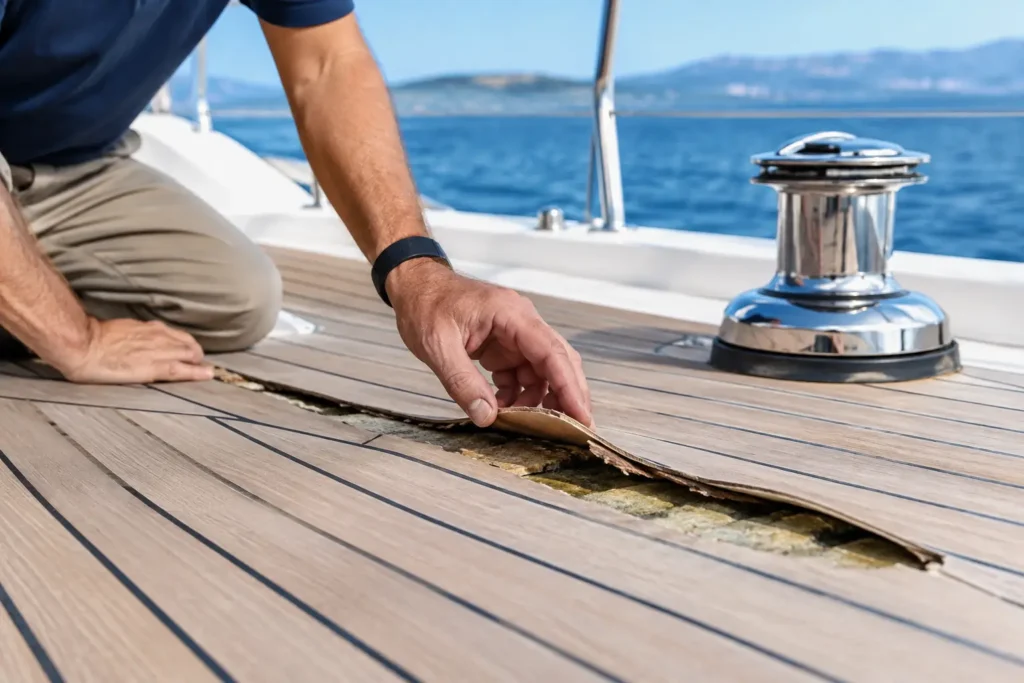
A deck can look clean, feel solid underfoot, and still conceal a costly structural problem. The most reliable signs of deck delamination are often subtle: a change in sound, a local loss of stiffness, moisture around a fitting, or a repair that does not quite match the surrounding laminate. For a yacht buyer, these details deserve measured investigation rather than assumption. For an owner, identifying them early can turn a contained repair into a manageable maintenance decision.
On many FRP yachts, the deck is a sandwich structure. Fibreglass skins are bonded to a lightweight core, commonly balsa or foam. This construction offers excellent stiffness without excessive weight, but it relies on sound bonding and dry core material. When water enters through poorly sealed fasteners, deck hardware, hatches, chainplates, stanchion bases, or failed seams, the bond can weaken and the core may deteriorate. Delamination is the separation of these layers. It is not always visible from above.
What deck delamination actually means
Delamination is sometimes used loosely to describe any soft area in a deck. Technically, it may involve separation between the top skin and the core, separation between the lower skin and the core, or failure within the laminate itself. In a balsa-cored deck, moisture can also lead to decay of the core. In foam-cored construction, water may not rot the core, but it can still compromise adhesion, create freeze-related damage in colder climates, or allow the core to crush under repeated load.
The practical concern is stiffness, load transfer, and the route by which water entered. A small debonded area beneath a lightly loaded section of deck may be repairable without major disruption. The same issue around a mast step, genoa track, chainplate, deck-stepped rig support, or heavily loaded cleat requires more urgent attention. Location matters as much as size.
7 signs of deck delamination to investigate
1. A dull or uneven sound during tap testing
An experienced surveyor uses light percussion testing to listen for changes in the response of the deck. Sound laminate generally produces a sharper, more consistent note. A debonded area can produce a flatter, duller sound. The transition may be gradual or sharply defined.
Tap testing is useful because it can quickly identify areas requiring closer assessment, but it is not definitive by itself. Thick laminates, non-skid finishes, backing plates, deck furniture, and internal liners can all affect the sound. A finding should be interpreted alongside the construction method, moisture readings, visible condition, and access from below.
2. Local softness or movement underfoot
A deck that deflects noticeably when walked on is one of the clearest warning signs. It may feel spongy, flex beneath a heel, or produce a faint crackling sound under load. On a well-built composite deck, very small movement can be normal in broad, lightly supported panels, particularly on larger yachts. What is concerning is a localised change compared with adjacent areas.
Do not test suspicious sections by jumping on them. Excessive point loading can worsen an already weakened panel and can be dangerous near hatches or unsupported areas. A controlled inspection is more informative than a dramatic test.
3. Cracks, crazing, or distortion around fittings
Cracks in gelcoat do not automatically mean structural damage. Some are cosmetic stress crazing, especially on older vessels. However, cracking around stanchion bases, winches, cleats, deck organisers, hatch corners, and rail fittings deserves close attention. These locations concentrate load and are common water-entry points.
Look for radiating cracks, depressed areas around fasteners, lifted sealant, loose hardware, or staining at the base of a fitting. A fitting that has been repeatedly re-bedded without correcting wet or damaged core may appear tidy on the surface while the underlying issue continues to spread.
4. Elevated moisture readings in a pattern
Moisture meters are valuable survey tools, but they do not directly measure water inside a deck core. They measure electrical response, which can be influenced by moisture, laminate thickness, conductive materials, fillers, carbon reinforcement, metal backing plates, and even surface contamination.
The meaningful result is usually a pattern, not one high reading. Elevated readings concentrated around deck penetrations, extending from a leaking hatch corner, or differing significantly from comparable areas can support concern about moisture ingress. Readings should be taken systematically and interpreted with an understanding of the vessel’s materials and internal arrangement.
5. Leaks or staining below deck
A water stain on a headliner, a damp locker, corrosion on a backing plate, or brown liquid appearing near an internal fastener can identify the likely route of ingress. On balsa-cored decks, brown staining may indicate deterioration of the core, although laboratory certainty is not possible from colour alone.
The absence of visible leaks is not reassurance. A yacht may have been stored in dry conditions, recently cleaned, or fitted with interior liners that conceal the underside of the deck. Water can also travel along fasteners, wiring conduits, or structural members before becoming visible somewhere else.
6. Loose fasteners or failing bedding compound
Deck hardware should feel secure. A stanchion that moves, a winch base with uneven sealant, or a hatch frame that lifts at one corner may be evidence of degraded bedding, compression damage, or weakened substrate. Water often enters slowly through hardware that has loosened only slightly over years of use.
Removing a fitting can be the most direct way to inspect the core, but it is an intrusive step. During a pre-purchase survey, the appropriate approach depends on consent, timing, the apparent risk, and the effect on the transaction. When findings justify it, targeted fastener removal or core sampling may be recommended as a condition of purchase or before repair pricing is finalised.
7. Previous repairs that need explanation
A different non-skid pattern, fresh paint within a defined area, a line of filled fasteners, or an unusually smooth patch can indicate previous deck work. Previous repair is not a defect in itself. A correctly executed core replacement, documented with photographs and materials information, can be a positive sign of responsible ownership.
Concern arises when the repair boundary is unclear, surrounding moisture patterns remain elevated, or there is no explanation of why the work was undertaken. Ask what caused the damage, how far it extended, whether the source of water ingress was eliminated, and whether the repair was inspected after completion.
Why a soft deck is not always a delaminated deck
It is tempting to reach a conclusion from feel alone, but several conditions can imitate delamination. Flexible moulded panels may have limited support by design. A worn teak overlay can move independently of the composite deck beneath it. A loose headliner, detached interior liner, or poorly supported hatch surround may create a misleading sound during testing.
Conversely, a deck can feel firm while moisture has begun to enter a core near fittings. The early stages of damage may be localised and inaccessible. This is why a thorough assessment combines visual inspection, percussion testing, moisture mapping, examination from below where possible, and a review of likely water-entry points. Each method has limitations; their value is in the combined evidence.
The areas that deserve particular attention
Deck penetrations should receive priority because they interrupt the protective laminate. On sailing yachts, inspect around stanchions, pulpits, pushpits, chainplates, genoa tracks, mast partners, traveller tracks, winches, clutches, and deck organisers. On motoryachts, pay close attention to rail bases, cleats, windlass foundations, flybridge supports, tender chocks, hatches, sunpad fixings, and areas around large glazed openings.
Teak decks deserve separate consideration. Water can reach the substrate through failed caulking, worn plank thickness, loose screws on older installations, or compromised seams at margins and deck fittings. Repair scope can range from local re-bedding to removal of the teak and extensive core work. A proper diagnosis before committing to replacement avoids treating the visible finish while leaving the underlying cause unresolved.
What to do when you suspect a problem
Avoid cosmetic sealing as a first response. Applying more sealant over a leaking fitting may slow water entry, but it does not establish whether the core is already affected or whether the fitting is correctly bedded. The repair should begin with identifying the source, defining the extent of damage, drying or removing compromised material as appropriate, rebuilding the laminate, and re-bedding hardware with suitable load distribution.
For a buyer, deck concerns should be recorded precisely in the survey findings, with the location, evidence, limitations of inspection, and recommended next step clearly stated. Depending on the risk, that step may be a specialist inspection, targeted destructive testing, repair quotations, or a negotiated retention. An unsupported estimate is rarely useful when structural repair access can drive cost as much as the damaged area itself.When identifying core saturation and failing laminates during an inspection, it helps to understand what is systematically checked during a comprehensive marine survey.
For an owner, early investigation is usually the economical choice. The Blue Matter approaches these findings with evidence rather than alarm: distinguish a cosmetic issue from a structural concern, establish what is known, and identify what still needs verification. A properly investigated deck gives you something more valuable than reassurance – a defensible basis for repair, negotiation, and safe use of the yacht.
About the Author
Mustafa Aksut is an experienced independent marine surveyor, yacht refit project manager, and founder of Blue Matter Marine Consulting in Turkey. Holding an Associate IIMS designation and professional membership with the American Boat and Yacht Council (ABYC), he specializes in pre-purchase yacht condition surveys, thermal imaging diagnostics, technical due diligence, and new build project oversight. Operating with 100% independent loyalty to the client, Mustafa never practices brokerage, performs repair work, or acts for boatyards and refit centers—ensuring strictly unbiased surveys and uncompromised owner representation.