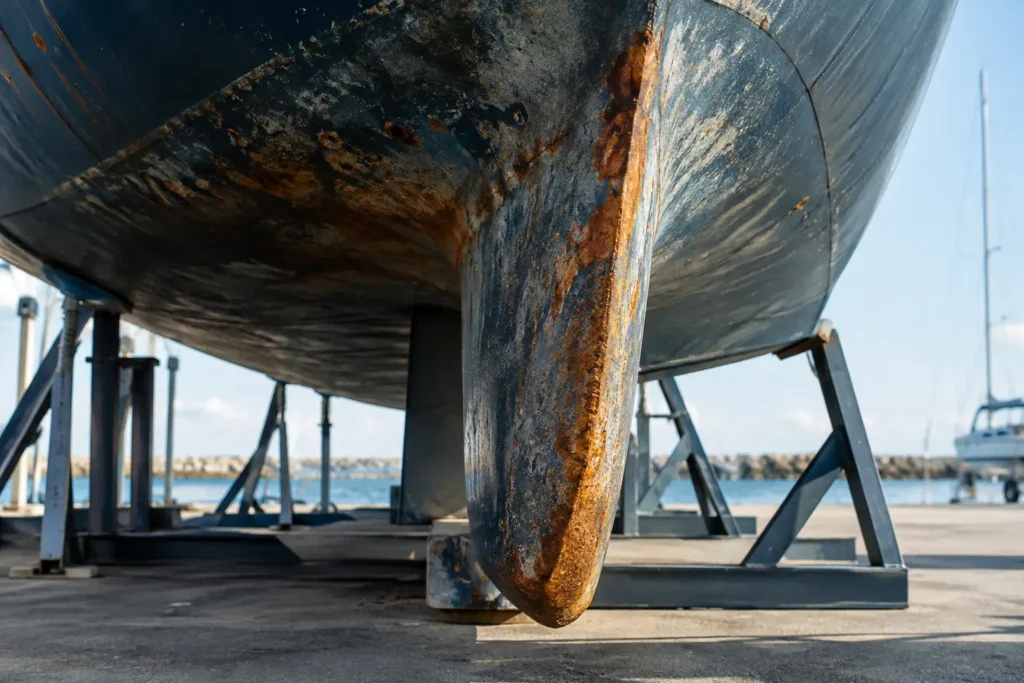
A keel corrosion case rarely begins with an obvious warning. A yacht may stand correctly in the yard, sail well, and present a clean bilge, while deterioration is developing at keel bolts, within a cast-iron keel, or at the hull-to-keel joint. For a buyer, the concern is not simply whether corrosion exists. It is whether the corrosion has reduced structural integrity, whether its extent can be established, and whether the proposed remedy is technically and financially realistic.
Corrosion should therefore be assessed as a condition issue, not treated as a cosmetic defect or a reason for immediate alarm. The material involved, the boat’s history, the evidence available during survey, and the ability to inspect critical areas all affect the conclusion.
Why a keel corrosion case deserves careful investigation
The keel is a primary structural component. It provides ballast, contributes to stability, and transfers sailing and grounding loads into the hull structure. Its attachment is equally critical. When corrosion affects fasteners, internal reinforcement, encapsulated metalwork, or the keel itself, the question is not limited to appearance. It concerns the boat’s capacity to carry the loads for which it was designed.
A common mistake is to judge the problem from rust staining alone. Surface rust on an uncoated cast-iron keel may be unsightly but manageable. Rust weeping from a keel-to-hull joint, persistent moisture around keel bolts, cracking in the adjacent laminate, or distortion of internal floors may indicate a more significant issue. None of these signs proves failure by itself, but each calls for a methodical inspection.
The type of construction matters. A lead keel does not corrode in the same manner as cast iron, although lead keels can still suffer from impact damage, distorted bolts, poor fairing repairs, and galvanic interaction with other metals. Cast-iron keels are particularly vulnerable where coatings have failed or water is retained against the metal. Stainless-steel keel bolts can be durable, yet they are not immune to crevice corrosion where oxygen is limited and moisture remains trapped. Galvanised fasteners have their own expected ageing pattern.
Where surveyors look for evidence
A proper assessment starts with the vessel ashore, with the keel washed and accessible. The external inspection considers the keel surface, grounding damage, coating condition, fairing compound, signs of movement at the joint, and any local distortion or cracking in the hull. Fresh paint is not evidence of soundness. It may be part of routine maintenance, or it may conceal a repair that needs further explanation.
Inside the yacht, attention turns to the bilge and the load path above the keel. A surveyor will inspect accessible keel bolts, nuts, washers, backing arrangements, floors, frames, tabbing, and surrounding laminate. Brown staining, flaking metal, dampness, cracked coatings, distorted structure, or previous local repairs are all relevant observations. Equally relevant is what cannot be seen. On many yachts, tanks, cabin soles, machinery, or built-in furniture limit access to areas that would otherwise provide useful evidence.
Moisture readings, percussion testing, and selective ultrasonic thicknes measurements can support an investigation, but each has limitations. Moisture meters do not diagnose a corroded bolt. Ultrasonic readings on irregular, coated, or heavily corroded castings require careful interpretation. A sounding response can suggest voids or debonding, but it does not replace opening up the structure where serious doubts remain.
Service history is often highly valuable. Records of a grounding, keel removal, bolt replacement, epoxy treatment, or insurance repair can help establish the sequence of events. Absence of records does not automatically mean poor work, but it increases uncertainty. In a high-value transaction, uncertainty has a cost and should be reflected in the buyer’s decision, price negotiation, or further inspection scope.
The hull-to-keel joint
The joint between hull and keel requires close attention because it can reveal movement, impact history, or deterioration in bedding materials. A narrow, consistent line may be normal for a particular design. An open joint, uneven gap, fresh sealant over damaged laminate, or cracking radiating into the hull should be investigated further.
This is particularly important after a suspected grounding. A yacht can appear satisfactory afloat while impact loads have caused damage within the bilge, at the internal grid, or around the bolt landings. The yard history and the owner’s account should be considered, but neither should replace physical evidence.
When corrosion is manageable and when it changes the purchase decision
Not every finding indicates rejection of a yacht. Light external oxidation on a cast-iron keel, with no evidence of section loss, movement, or structural distress, is generally a maintenance matter. The appropriate work may include proper preparation, coating repair, and regular monitoring.
The position changes where there is material loss, inaccessible but suspect keel bolts, evidence of crevice corrosion, cracking around structural members, recurring water ingress, or signs that a previous repair has not addressed the underlying cause. In those cases, a buyer may need a specialist engineering opinion, removal of selected fittings or sole boards, local dismantling, or a yard quotation for keel removal and bolt replacement.
Keel bolt replacement is not a routine cosmetic job. Depending on the design, it can require lifting or separating the keel, supporting the hull correctly, machining or extracting fasteners, repairing damaged structure, rebedding the keel, and completing alignment and fairing work. The final cost depends heavily on access and the condition found once the keel is removed. A low initial estimate should be treated cautiously if it does not account for contingencies.
There are occasions when the right commercial decision is to proceed, but only with a clear allowance for the work. There are also occasions when the condition, lack of access, or uncertainty is disproportionate to the yacht’s value. An independent survey should distinguish between these positions rather than offering a vague recommendation to “monitor.”
How buyers should respond to a suspected keel issue
Buyers should avoid accepting verbal reassurance in place of evidence. Ask what has been observed, what has not been accessible, what further investigation could establish, and what risk remains if that investigation is not undertaken. A good report should separate factual findings from assumptions and explain the practical implications.
It is also sensible to keep the survey and negotiation processes connected. If a defect is identified before contract completion, the buyer may seek a price adjustment, require the seller to complete work to an agreed standard, or make the purchase conditional upon further inspection. Seller-funded repairs can be appropriate, but they should be properly specified and independently checked. A quick yard repair without documented scope, photographs, and final inspection may create more questions than it resolves.
For sellers, early disclosure and clear repair records can protect a transaction from late-stage disruption. A known issue presented honestly, with credible supporting documentation, is usually easier to manage than corrosion discovered after a buyer has committed time and expense to the purchase process.
Survey scope and honest limitations
A pre-purchase survey is a detailed visual and non-destructive examination within agreed access and time limits. It is not a guarantee that every hidden defect will be found. Keel structures are a good example of why scope matters: some of the most important areas may be concealed behind internal joinery or below a heavy keel casting. Evaluating structural keel bolts and exterior ballast joint integrity is a primary focus when examining what is done in a standard marine survey.
That limitation is not a reason to disregard the survey. It is a reason to use the findings intelligently. An experienced independent surveyor identifies the visible evidence, explains the significance of restricted access, and recommends proportionate next steps where the risk justifies them. The Blue Matter approaches such decisions with the same principle applied to every significant yacht defect: clear evidence first, practical advice next, and no pressure toward a predetermined outcome.
A yacht purchase should leave room for informed caution. If keel corrosion is suspected, the most valuable result is not a reassuring phrase or an alarming label. It is a clear understanding of what is known, what remains uncertain, and what it will take to make the yacht safe to own with confidence.
About the Author
Mustafa Aksut is an experienced independent marine surveyor, yacht refit project manager, and founder of Blue Matter Marine Consulting in Turkey. Holding an Associate IIMS designation and professional membership with the American Boat and Yacht Council (ABYC), he specializes in pre-purchase yacht condition surveys, thermal imaging diagnostics, technical due diligence, and new build project oversight. Operating with 100% independent loyalty to the client, Mustafa never practices brokerage, performs repair work, or acts for boatyards and refit centers—ensuring strictly unbiased surveys and uncompromised owner representation.