What Is Included in a Sea Trial During a Marine Survey? Checklist & Guide
Answered by Mustafa Aksut, Accredited Marine Surveyor, IIMS, ABYC, and Navtech USSA Member
An underway sea trial is one of the most critical phases of a pre-purchase marine survey. While static dockside inspections evaluate hull integrity, electrical systems, and structural laminates, a sea trial tests the vessel’s propulsion, steering, navigation systems, and structural response under actual operational loads at sea.
Understanding what is systematically evaluated during a sea trial helps buyers, sellers, and captains prepare the vessel for maximum efficiency and safety during the evaluation.
1. Engine & Mechanical Systems Under Load
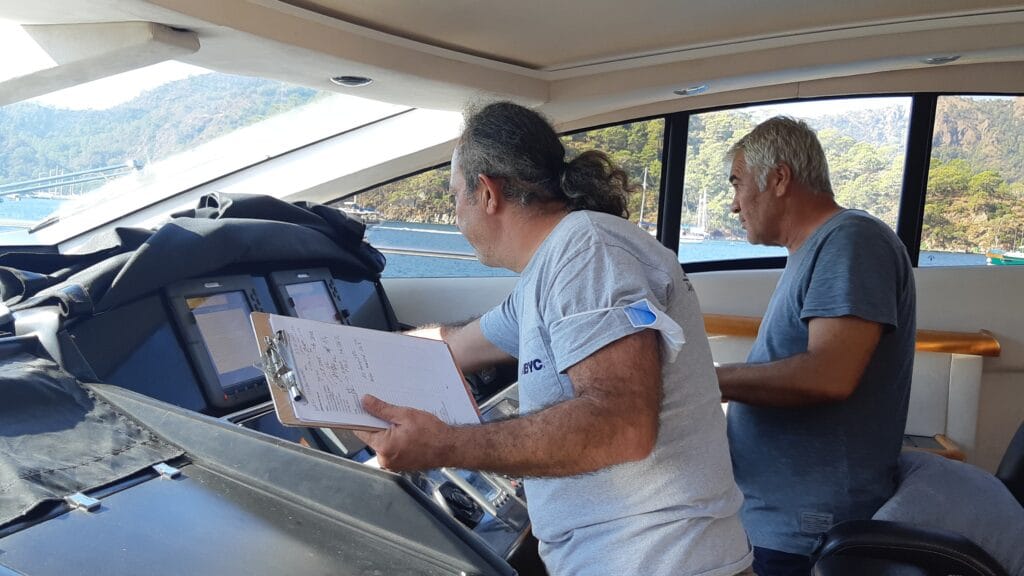
Static idle testing at the dock cannot replicate the thermal and mechanical stresses experienced while moving through the water. During a sea trial, the marine surveyor monitors key mechanical parameters under load:
- Wide Open Throttle (WOT) Performance: Running engines at full rated RPM to ensure they reach manufacturer specifications without overheating or exceeding operating temperature thresholds.
- Thermal & Exhaust Evaluation: Using infrared thermal imaging or digital gauges to check exhaust risers, heat exchangers, turbochargers, and shaft seal temperatures under load.
- Transmission & Shift Response: Testing forward, neutral, and reverse gear engagement, throttle smoothness, and checking for transmission slippage or excessive vibration.
- Blowby & Exhaust Smoke Inspection: Observing exhaust output under acceleration for excessive black, white, or blue smoke indicative of fuel injector, turbo, or piston ring wear.
2. Helm Controls, Steering & Running Gear
The sea trial provides the only opportunity to evaluate dynamic underwater components and steering responsiveness under pressure:
- Steering System Response: Checking hydraulic or mechanical steering systems hard-to-port and hard-to-starboard at cruising speeds to verify responsiveness and lock-to-lock performance.
- Trim Tabs & Interceptors: Verifying pitch control, port/starboard trim tab response, and automatic stabilization systems.
- Vibration & Shaft Alignment Checks: Detecting drivetrain misalignment, bent propeller shafts, or damaged prop blades through hull resonance and tactile vibration checks at varying speed ranges.
- Bow & Stern Thrusters: Testing electric or hydraulic thruster operation under current and wind resistance.
3. Navigation Electronics & Auxiliaries Underway
Integrated navigation systems and auxiliary generators are evaluated in active operating conditions:
- GPS, Chartplotters & Autopilot: Verifying position accuracy, heading sensors, waypoint tracking, and testing autopilot response underway.
- Radar & Depth Sounders: Confirming radar target tracking, gain control, and depth sounder signal retention at cruising speeds.
- Generator Under Load: Running the auxiliary generator simultaneously with heavy AC electrical loads (HVAC units, electric galleys, watermakers) while underway.
4. Sailboat-Specific Sea Trial Inspections
For sailing vessels, the sea trial includes raising canvas to evaluate the sailing rig in action:
- Sail Condition & Furling Gear: Unfurl/hoist mainsails and headsails to inspect stitching, boltropes, UV covers, and furling mechanism operation.
- Standing Rigging Under Strain: Observing stay and shroud tension, chainplate flexing, and mast bend under sail power.
- Winch & Running Rigging Checks: Testing primary winches, halyards, sheets, and clutches under active sail load.
Frequently Asked Questions About Sea Trials
Q: How long does a sea trial take during a marine survey?
A: A standard sea trial typically takes 1 to 2 hours underway, allowing sufficient time to bring engines to operating temperatures and conduct full WOT tests.
Q: Who operates the boat during a sea trial?
A: The boat owner, listing broker, or a licensed captain operates the vessel. Marine surveyors do not act as captains or navigate the boat so they can focus entirely on diagnostic evaluations.
Q: What is the difference between a sea trial and a dockside survey?
A: A dockside survey tests static systems and electrical components at rest, while a sea trial evaluates engine performance, dynamic stability, steering, and electronics under actual sea conditions.
Related Marine Survey Resources
Explore additional guides from our FAQ hub to prepare for your inspection:
- FAQ Hub: Return to the central Marine Survey FAQ Hub.
- Duration & Timelines: Review overall inspection schedules in how long a marine survey takes.
- Survey Scope: Understand visual testing parameters in what is done in a marine survey.
- Survey Limitations: Learn about non-destructive boundaries in what are the limitations of a marine survey.

Mustafa Aksut is an Accredited Marine Surveyor with proven observation skills and solid technical knowledge. Mustafa gained extensive work experience while working as a marine Surveyor in Turkey and as a Marine service expert in Canada and the Bahamas.
He has completed a wide variety of projects, including but not limited to complete refits, electronics, electrical, engines and mechanical, plumbing, refrigeration, rigging, and safety systems on both sailing and motor yachts up to 150 feet in size.
Mustafa Aksut, with years of experience, is a leading marine surveyor who helps clients feel assured about their boats. He has personally inspected a wide range of vessels, from modern catamarans to traditional wooden yachts. His surveys include boats as small as 26 feet and as large as 150 feet, always with meticulous detail.
He has also managed many large refit projects for both wooden and fibreglass boats. This hands-on work allows him to spot problems early and provide smart advice that others might miss.
Mustafa Aksut, as an early adopter of the technology, uses proven tech for his inspections. To be able to reveal the entire story of the vessel, Mustafa uses thermal imaging, oil analysis, ultrasonic testers and more. Technology backs up the marine surveyor with more accurate non-destructive testing possibilities
Whether you’re buying a boat, checking on your current one, or planning a major project, Mustafa Aksut is the expert you can trust. His direct and clear reporting style and straightforward approach give you the confidence to feel safe while cruising.
Mustafa Aksut is a member of ABYC (American Boat and Yacht Council) ABYC standards are the foundation of his practice. Learn more about ABYC standards.
Mustafa Aksut also holds an Assoc IIMS from IIMS (International Institute of Marine Surveying) and Master Marine Surveyor credential through Navtech-USSA (US Surveyors Association).