
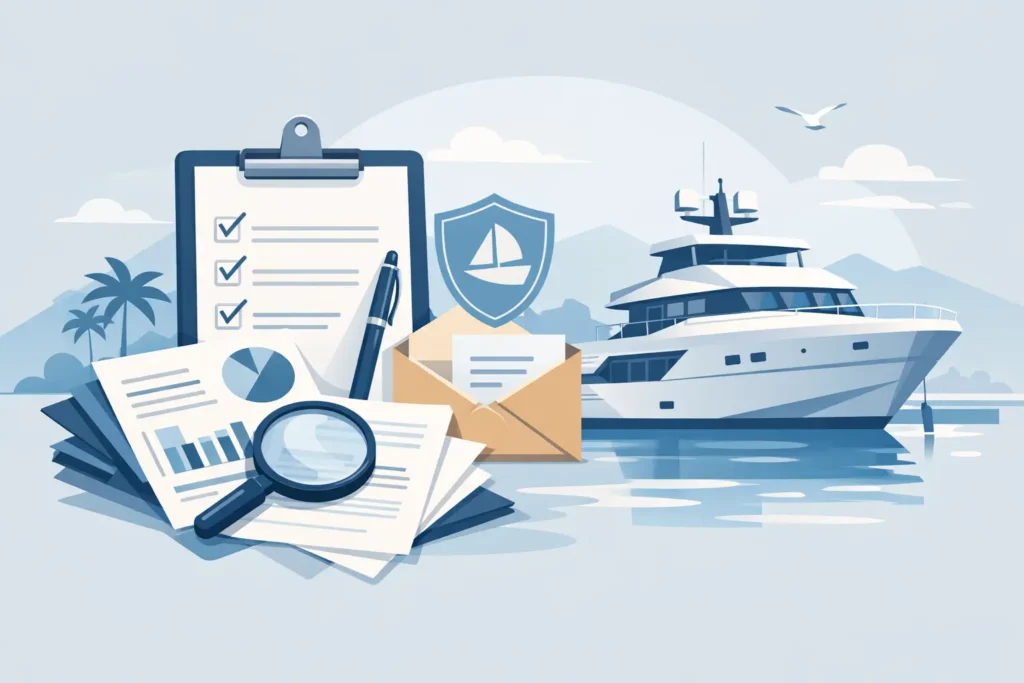
A yacht can present beautifully at the dock and still carry serious legal, technical, or financial problems on paper. That is why the best documents before buying a yacht are not just administrative formalities – they are part of your due diligence, and in many cases they tell you as much as the vessel itself.
For buyers in Turkey and across the Mediterranean, document review should begin early, well before closing and ideally before you commit significant funds to haul-out, sea trial, and survey costs. Some paperwork confirms ownership and status. Other records reveal how the yacht has been operated, maintained, modified, and, at times, neglected. The aim is not to collect paperwork for its own sake. The aim is to reduce uncertainty and avoid buying hidden problems.
Why the best documents before buying a yacht matter
A pre-purchase survey is essential, but a survey is only one part of the decision. A competent inspection can identify structural defects, machinery issues, moisture intrusion, poor repairs, and safety concerns. It cannot by itself prove clear title, unpaid debts, tax status, or whether a major engine rebuild claimed by the seller actually took place.
This is where documentation becomes decisive. A clean set of records supports value, helps establish legal certainty, and often makes negotiations more precise. Missing or inconsistent documents do not always mean the yacht is a bad purchase, but they should change how cautiously you proceed, what additional checks you request, and how you evaluate price.
The ownership and registration documents to request first
The first category is legal identity. Before anything else, ask for the current certificate of registry or equivalent national registration document, together with the builder’s certificate if available and prior bills of sale that show a traceable chain of ownership.
These records help answer basic but critical questions. Is the seller the legal owner? Is the yacht properly registered under the flag stated in the listing? Do the hull identification details match the vessel you are inspecting? Even a simple mismatch in hull number, tonnage, engine serial number, or owner name can signal deeper issues that need clarification.
If the yacht is company-owned rather than privately owned, request company authorization documents showing who has the legal authority to sell. In practice, delays and disputes often arise not because the yacht is defective, but because the person negotiating does not have clean authority to transfer title.
Bills of sale and chain of title
Bills of sale deserve close attention. Ideally, they should show an uninterrupted chain from one owner to the next. Gaps are not automatically fatal, especially with older yachts that have changed flag, changed ownership structure, or passed through several jurisdictions. Still, any break in the chain should be explained clearly and supported where possible by registry extracts or supporting declarations.
For buyers, the practical question is simple: can the seller deliver good title at closing? If that answer is uncertain, every other attractive feature of the yacht becomes secondary.
Encumbrances, mortgages, and debt checks
One of the most overlooked parts of yacht due diligence is checking whether the vessel is free from registered mortgages, liens, or other encumbrances. A yacht may look like a straightforward private sale while still carrying debt or unresolved financial claims.
Ask for a recent transcript or registry extract from the relevant flag administration where such records are available. In some jurisdictions, this will show registered mortgages and ownership history. In others, additional searches or lawyer-led checks may be needed. Marina debts, yard invoices, crew claims, and other maritime liens are not always easy to detect from a simple certificate, which is one reason high-value purchases should be handled carefully.
This is an area where buyers should resist assumptions. “We have never had a problem” is not a substitute for evidence.
VAT status, importation, and customs records
In Turkey and the wider Mediterranean, tax and customs status can materially affect both use and resale. Buyers should request VAT evidence, importation records where relevant, and any customs documentation that confirms the yacht’s status in the jurisdiction where it is lying or operating.
The exact documents vary by flag, ownership structure, and cruising history. A yacht may be VAT paid, VAT not paid, temporarily imported, commercially registered, or subject to a more complex structure. Each case has practical implications. You may be able to use the yacht in one way but not another. You may also inherit uncertainty that affects future saleability.
This is a classic example of why document review cannot be treated as a box-ticking exercise. A missing invoice or unclear import trail may be manageable, or it may become expensive very quickly. It depends on the yacht’s history and your intended use.
Maintenance records often tell the real story
If legal documents establish what the yacht is, maintenance records often reveal what it has become. Ask for engine service records, generator service history, invoices for repairs, yard periods, antifouling records, rig inspections on sailing yachts, and any major replacement or refit documentation.
These records matter because they add context to what a surveyor sees. A clean engine room with fresh paint is less persuasive than documented maintenance intervals, oil analysis, injector service, heat exchanger work, or evidence of a proper overhaul. The same is true for standing rigging, teak decks, electronics upgrades, tank repairs, stabilizers, and air-conditioning systems.
Logbooks and operating history
Logbooks can be surprisingly useful when they are detailed and credible. They may show engine hours over time, passages completed, recurring faults, maintenance routines, and periods of inactivity. That last point matters. A yacht that has sat idle for extended periods may show fewer hours, but inactivity can create its own set of problems in machinery, seals, fuel systems, batteries, and onboard equipment.
Well-kept records usually suggest disciplined ownership. Poor records do not automatically prove poor maintenance, but they do remove evidence you would otherwise rely on.
Previous surveys, damage reports, and insurance documents
Ask whether previous condition surveys, valuation reports, insurance surveys, or damage repair reports are available. Sellers are not always eager to provide them, particularly if they mention defects, but they can be extremely informative.
A past survey may highlight recommendations that were either completed properly, completed poorly, or ignored altogether. An insurance-related repair file may document grounding damage, collision repair, osmosis treatment, structural reinforcement, or machinery failure. Those events do not necessarily make the yacht a poor purchase. In some cases, documented professional repairs are preferable to undocumented history. The concern is not that damage occurred. The concern is whether it was disclosed, repaired to a proper standard, and reflected fairly in value.
Manuals, equipment certificates, and compliance paperwork
The best documents before buying a yacht also include the less dramatic but still important technical file. This includes owner manuals, equipment manuals, CE documentation where applicable, life raft servicing records, fire system inspection certificates, EPIRB and radio licensing details, and service certificates for critical safety equipment.
These records support the practical handover of the yacht, but they also reveal how systematically the vessel has been managed. Missing manuals are inconvenient. Missing compliance or safety servicing records can be more serious, especially if you intend to operate soon after completion.
For larger or more complex yachts, machinery and system documentation also affects future maintenance efficiency. Engineers and service technicians work faster and more accurately when documentation exists and serial numbers match installed equipment.
What to do when documents are incomplete
Not every sound yacht comes with a perfect paper trail. Older vessels, family-owned boats, and yachts that have moved between countries often have gaps. The key is not to react emotionally. Instead, assess what kind of gap you are dealing with.
A missing owner’s manual is minor. Missing title evidence is major. Incomplete service invoices may be manageable if the yacht’s condition supports the seller’s claims and your survey findings are strong. Missing VAT proof, unresolved mortgage questions, or undocumented structural repairs deserve a much more cautious response.
This is where independent advice matters. At The Blue Matter, we often see buyers focus first on cosmetics and equipment inventories, when the more important risk sits in title, tax status, or undocumented technical history. Good advice helps you separate negotiable imperfections from deal-changing issues.
How documents and survey findings work together
The strongest purchase decisions come from combining paperwork review with physical inspection, sea trial, and valuation thinking. Documents can confirm, contradict, or deepen what the survey reveals.
If records show recent engine work, the surveyor can look more closely at installation quality, commissioning, and supporting evidence. If the seller claims no history of grounding but repair invoices suggest keel or hull impact work, that inconsistency deserves attention. If service logs are excellent but onboard condition is poor, you may need to question how recent or complete those records really are.
No single document makes a yacht safe to buy. No single defect makes it unsafe to buy. Yacht transactions are rarely that simple. The goal is to build a coherent picture from facts, not assumptions.
When the paperwork is orderly, the vessel identity is clear, the tax position is understood, and the technical history aligns with survey findings, you are in a far stronger position to proceed with confidence. And if the documents raise more questions than they answer, that is useful too – because a careful buyer would always rather discover uncertainty before completion than pay to inherit it later.

4 Responses