
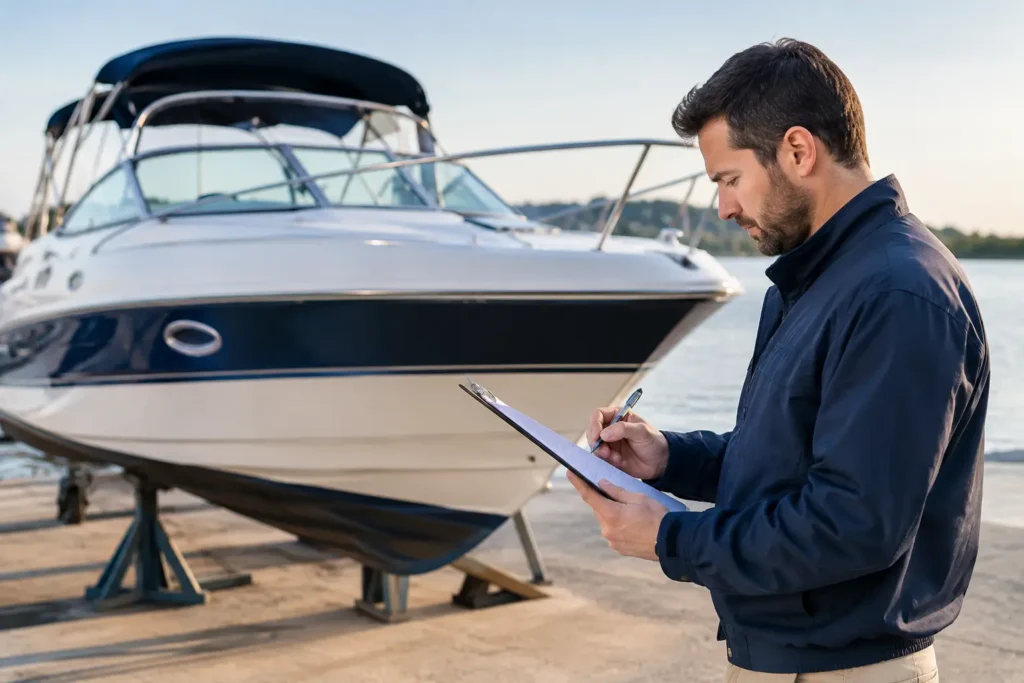
An insurer may be prepared to quote on a yacht from a short description, a declared value, and a photograph. That does not mean it will accept the risk indefinitely. Once a vessel reaches a certain age, value, operating area, or claims profile, boat insurance survey requirements often become central to obtaining cover, renewing a policy, or removing exclusions that could matter when a loss occurs.
For owners and buyers in Bodrum and across the Mediterranean, the practical issue is not simply whether a survey is needed. It is understanding which survey the insurer expects, what the report must establish, and whether the resulting recommendations can realistically be completed before the policy deadline. A survey is evidence, not a formality. It gives an underwriter an independent view of the vessel’s condition and the risks it presents.
When Do Insurers Require a Survey?
There is no universal age or value threshold. Each insurer sets its own underwriting standards, and requirements may also vary by flag, cruising limits, vessel type, construction, and intended use. A relatively new production yacht may be accepted without a current survey, while an older vessel of modest value may require one because of its age, systems, or construction.
Insurers commonly ask for a survey when a boat is being insured for the first time, particularly after a change of ownership. They may also request one at renewal intervals, after a substantial refit, following a claim, or when an owner wishes to extend cruising grounds. A yacht moving from local coastal use to wider Mediterranean passages presents a different exposure, even if its insured value has not changed.
Older yachts deserve particular attention. Many insurers request a current condition and valuation survey for vessels over 10 to 15 years old, with more frequent evidence of condition as the boat ages. This is a guideline rather than a rule. A well-documented 25-year-old yacht with recent machinery, rigging, and electrical upgrades may be viewed more favourably than a newer vessel with unclear maintenance history.
What Boat Insurance Survey Requirements Usually Cover
An insurance survey is generally a condition-focused inspection. Its purpose is to identify defects or deficiencies that could lead to a loss, such as flooding, fire, grounding damage, machinery failure, or loss of steering. It is not automatically as extensive as a pre-purchase survey, although the two may overlap significantly.
The surveyor will normally inspect the hull, deck, superstructure, structure where accessible, and signs of repair or moisture-related deterioration. Through-hull fittings, seacocks, hoses, clamps, bilge arrangements, pumps, fuel systems, fire safety equipment, electrical installation, batteries, steering gear, anchoring equipment, and navigation lights are typically considered from a safety and insurability perspective.
On sailing yachts, standing rigging age and visible condition are frequent underwriting concerns. Insurers may apply specific rigging replacement intervals or require a rigger’s report, even if the mast and rig appear serviceable during a general survey. On motor yachts, fuel systems, exhaust arrangements, engine-room fire protection, and machinery maintenance records can receive closer scrutiny.
A hull inspection ashore is often expected, especially for older vessels or where there is no recent evidence of underwater condition. The surveyor can then assess the hull, keel or running gear, rudders, propellers, shafts, skin fittings, and the condition of antifouling and sacrificial anodes. On FRP vessels, the inspection may also consider evidence of osmosis, impact damage, previous repairs, and structural cracking. For wooden or classic yachts, access to fastenings, planking, frames, caulking, and areas vulnerable to rot becomes especially significant.
Condition and Valuation Are Different Findings
Many insurers request a condition and valuation survey, but these are distinct conclusions. Condition addresses whether the vessel is maintained to an acceptable safety standard and identifies defects requiring attention. Valuation provides an informed opinion of market value or, in some cases, replacement cost considerations.
The insured value should not be treated as an aspirational sale price. Over-insurance can create higher premiums without guaranteeing a higher claim settlement, while under-insurance can leave an owner exposed after a serious casualty. Accurate valuation depends on the vessel’s specification, age, condition, maintenance record, refit work, equipment, comparable market evidence, and local market realities.
The Difference Between an Insurance Survey and a Pre-Purchase Survey
A buyer should be cautious about relying on an insurance survey as a substitute for full technical due diligence. An insurance survey is designed to help an underwriter assess risk. A pre-purchase survey is designed to protect the buyer’s decision-making process.
A thorough pre-purchase inspection usually takes a wider and more forensic view of the vessel. It examines condition, construction, defects, maintenance standards, evidence of prior damage, operational concerns, and the likely implications for ownership. It may be coordinated with a sea trial, engine inspection, oil analysis, thermal imaging where appropriate, moisture readings, and specialist inspections of rigging or machinery.
An insurance report may identify an unsafe fuel hose or an expired fire extinguisher. A pre-purchase survey should also help a buyer understand whether the vessel has concealed water ingress, poorly executed repairs, deferred maintenance, or a refit liability that will materially affect the purchase price. For a high-value acquisition, commissioning the correct survey at the correct stage is usually less costly than discovering limitations after completion.
Recommendations, Deadlines, and Policy Conditions
The most consequential part of an insurance survey is often the recommendations section. Underwriters commonly divide recommendations by urgency. Some must be completed before cover is bound. Others may be accepted subject to a defined completion period, often with evidence such as invoices, photographs, or a contractor’s statement.
Typical recommendations include replacing degraded hoses, servicing fire extinguishers, correcting battery installation, renewing expired flares, fitting appropriate bilge alarms, repairing defective seacocks, or updating standing rigging. These may appear modest in isolation, but their cost and scheduling should be assessed honestly. A recommendation involving haul-out work, imported components, or specialist labour may not be resolved as quickly as an owner expects during a busy Mediterranean season.
Do not assume a recommendation is optional because the boat remains insured. Policies may include warranties, exclusions, or conditions that limit cover until specified work is completed. If a loss is connected to a known and uncorrected defect, the consequences can be serious. The right approach is to read the underwriter’s response carefully, agree realistic deadlines where possible, and retain a clear record of remedial work.
Preparing for the Survey Without Concealing Problems
Good preparation makes an inspection more efficient and makes the final report more useful. It should never mean masking faults. Independent surveyors are there to establish facts, and an accurate report serves both the owner and the insurer better than a superficially tidy vessel with hidden deficiencies.
Before the appointment, make the boat accessible and arrange haul-out if required. Assemble maintenance invoices, previous surveys, registration documents, equipment lists, machinery service records, rigging records, and details of major repairs or refits. If systems need keys, passwords, shore power, fuel, water, or crew assistance to operate safely, ensure these are available.
Owners should also disclose known defects and recent incidents. An honest record of a repaired grounding, water ingress event, or machinery issue allows the surveyor to focus on the relevant area and describe the repair evidence accurately. Concealment creates uncertainty. Clear documentation builds confidence.
Choosing a Surveyor Your Insurer Will Accept
Before booking, ask the insurer or broker what it requires. Confirm whether it needs a full condition and valuation survey, a limited insurance inspection, a rig survey, an out-of-water inspection, or a report using a specific format. Also confirm the maximum acceptable age of the report. Some insurers will not accept a document that is more than 12 months old, while others may have shorter limits during a purchase transaction.
The surveyor should be independent, suitably qualified, insured for professional work, and experienced with the vessel type and construction. A report should state the scope of inspection, limitations, findings, recommendations, and valuation basis clearly enough for an underwriter to act on it. It should distinguish observed facts from assumptions and avoid vague reassurance.
For yachts based in Turkey or moving through the eastern Mediterranean, practical local knowledge also matters. Access to haul-out facilities, the availability of specialist contractors, regional operating conditions, and the documentation commonly held by owners can affect both the inspection process and the path to compliance. The Blue Matter approaches this work with the same independence and factual discipline required for a sound purchase decision.
A well-prepared survey does more than satisfy an insurance request. It gives you a defined picture of the vessel’s present condition, a prioritised path for corrective work, and a stronger basis for discussing cover with confidence. That is useful information to have before the next renewal notice, not after a claim.

One Response