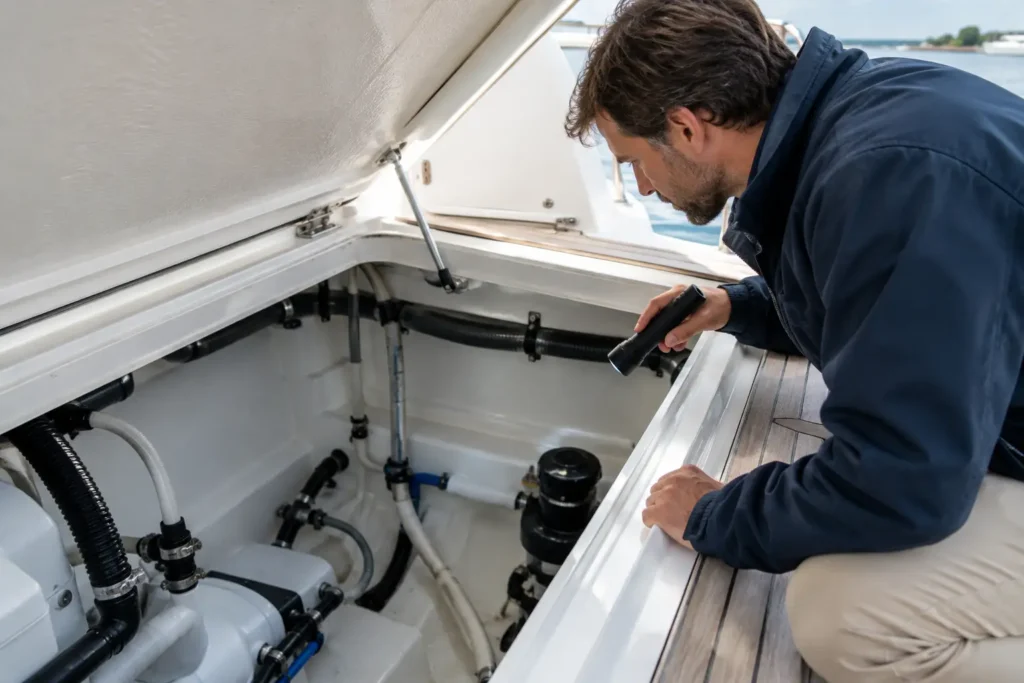
A yacht can present beautifully on deck while its bilges tell a very different story. Knowing how to inspect yacht bilges is one of the most useful practical skills for a buyer or owner, because this low, concealed area often records leaks, poor maintenance, corrosion, structural movement and machinery issues long before they become obvious elsewhere.
The bilge does not need to be spotless to be sound. A working yacht may have staining, dust, old paint or a small amount of clean water. What matters is the source, pattern and consequence of what you find. A careful inspection replaces assumptions with evidence. Clearing out locker spaces and bilge compartments ahead of time is critical; learn more in our guide on how to prepare your boat for an upcoming marine survey.
Why Bilges Matter in a Yacht Inspection
The bilge is the lowest internal area of a yacht, where water, fuel residue, dirt and debris naturally collect. It also contains or sits below critical systems: hull structure, keel bolts, limber holes, pumps, hoses, through-hull fittings, tanks, engines and shaft arrangements. On sailing yachts, it may reveal the condition of the keel connection. On motor yachts, it can show how well engine-space systems have been maintained.
For a prospective buyer, the bilge is valuable precisely because it is not a cosmetic space. Fresh paint may improve appearance, but it should invite closer examination rather than immediate confidence. A well-kept bilge generally suggests disciplined ownership, though it is not proof that every hidden system is in good order. Equally, a dirty bilge is not automatically a reason to reject a yacht. The surveyor’s task is to establish whether the conditions are superficial, active or structural.
How to Inspect Yacht Bilges Systematically
Begin only when the yacht is safely secured, adequately lit and accessible. Wear gloves, use a strong torch and bring a clean cloth or absorbent paper to identify the type of liquid present. Avoid placing hands around moving machinery, exposed electrical terminals or contaminated water. If a bilge contains fuel, chemical residue or an unidentified liquid, do not treat it as a routine cleaning issue.
Start at the forward end of the vessel and work aft, or follow the yacht’s watertight compartments in a consistent order. Open each accessible sole board, hatch and machinery-space access panel. Photograph anything that may require further investigation, particularly before a seller cleans or dries the area.
Check the Water, Not Just Its Level
A dry bilge is reassuring, but it is only one observation. Look for tide marks, damp surfaces, salt crystals, staining around fittings and water trapped beneath loose debris. These can indicate that water has been present even if pumps have recently cleared it.
Clear water may come from rain ingress, air-conditioning drains, freshwater plumbing or washdown. Saltwater residue can point to a leaking stern gland, shaft seal, through-hull fitting, deck leak that has migrated internally, or a hull breach. Oily water may arise from engine leaks, hydraulic systems, generators or gearbox work. A diesel smell is especially relevant, both from a maintenance and safety perspective.
Where practical, use touch and smell cautiously to distinguish fresh water from saltwater and oil. A surveyor may also trace likely routes by checking hose runs, clamps, surrounding surfaces and areas above the waterline. The source is more significant than the quantity at the moment of inspection.
Follow the Trail Above the Bilge
Water rarely arrives at the lowest point without leaving clues on its route. Examine bulkhead bases, stringers, engine beds, hose connections, tank supports and the underside of sole boards. Brown streaking from timber components, white salt deposits, mildew and softened insulation can all indicate repeated moisture exposure.
On an FRP yacht, pay attention to cracks in tabbing, detached bonding, exposed laminate, discoloured resin or persistent dampness at structural intersections. These signs require context. A superficial gelcoat crack is very different from cracking associated with movement of a bulkhead, engine bearer or keel structure.
On wooden or classic yachts, look closely at frames, floors, fastenings and plank seams. Darkened timber, soft areas, weeping fastenings or unusual filler can call for a specialist assessment. On steel and aluminium yachts, standing water is a more immediate concern because it can accelerate corrosion in poorly coated or inaccessible spaces.
Inspect Keel Areas and Structural Members
In a sailing yacht with an externally bolted keel, inspect the internal keel matrix, floors and visible keel bolts. Light surface oxidation on older fasteners may not be unusual, but heavy rusting, deep pitting, cracking around bolt locations, distorted floors or evidence of water tracking through the keel joint should never be dismissed without professional evaluation.
The same principle applies to stringers and transverse frames. Look for separation between bonded structure and hull, previous repairs, irregular filler or fresh paint that ends abruptly around a suspected area. None of these observations proves a defect on its own. They do, however, establish the questions that need to be answered during a full condition survey and, often, during a haul-out inspection.
Examine Pumps, Hoses and Through-Hull Connections
Bilge pumping arrangements are a direct safety issue. Check whether electric and manual pumps are installed, accessible and apparently maintained. Float switches should move freely, wiring should be secured and protected, and discharge hoses should be properly supported. Corroded connections, unsupported hoses or improvised wiring deserve attention.
Inspect hose clamps at through-hulls, seacocks, strainers and equipment connections. Marine-grade double clamping may be expected on critical below-waterline hose connections, depending on the installation and the hose type. Seacocks should be operable, correctly bonded where required by the vessel’s system design, and free from obvious corrosion or stiffness.
A pump that cycles frequently may be responding to an active leak. Ask when the bilge was last dry, how often the pumps operate, and whether the yacht has been left unattended for extended periods. Answers should be compared with the physical evidence, not accepted in isolation.
Look for Machinery-Space Evidence
On motor yachts and auxiliary sailing yachts, inspect beneath engines, transmissions and generators. Oil beneath an engine can result from a minor weep after servicing, but it can also signal neglected seals, overfilled systems or a long-standing leak. Check for staining around fuel filters, injector lines, cooling hoses and raw-water pumps.
Engine mounts and beds are equally relevant. Corrosion, loose fasteners, damaged paint, split flexible mounts or signs of movement may affect alignment and vibration. Around shafts, inspect the stern gland or mechanical seal area for excessive water ingress. Some traditional packing glands are designed to drip lightly when operating, while many modern seal systems should remain essentially dry. The correct assessment depends on the equipment fitted and how the yacht is used.
Do Not Ignore Smell, Debris or Unusual Cleanliness
Odour is evidence. A persistent musty smell can indicate poor ventilation or concealed moisture. Sour bilge water may point to stagnant water, while fuel or solvent odours require immediate care. Debris can block limber holes and prevent water from reaching the pump pickup, leaving pockets of water hidden within structural bays.
Unusual cleanliness also deserves a measured response. A freshly painted, dry bilge may reflect excellent preparation for sale. It may also conceal staining, repairs or corrosion. Ask when the work was completed, request invoices or photographs where available, and inspect transitions at the edge of the painted area. Independent verification is preferable to speculation.
When a Bilge Finding Needs a Surveyor
Some findings can be managed as routine maintenance: clearing debris, replacing a hose clamp, servicing a float switch or identifying a minor freshwater leak. Others should influence purchase negotiations, survey scope or the decision to proceed. These include unexplained saltwater ingress, fuel contamination, advanced corrosion, damaged structural bonding, cracked keel structure, persistent oil leakage and signs of flooding.
A pre-purchase survey considers bilge evidence alongside the yacht’s construction, age, maintenance records, machinery condition and out-of-water hull inspection. For example, water around keel bolts may be less alarming if testing and haul-out findings establish a sound keel joint, but much more significant if there is corresponding cracking or impact history.
The Blue Matter approaches bilge findings in that context: independently, with clear reporting and without overstating conditions that require monitoring rather than alarm. A useful report explains what was observed, why it matters, what remains uncertain and what action is appropriate.
Before committing to a yacht, allow enough time to inspect the places a sales presentation cannot improve. A clean torch beam through the bilge can lead to difficult questions, but asking them early is usually the most economical part of owning a yacht.
About the Author
Mustafa Aksut is an experienced independent marine surveyor, yacht refit project manager, and founder of Blue Matter Marine Consulting in Turkey. Holding an Associate IIMS designation and professional membership with the American Boat and Yacht Council (ABYC), he specializes in pre-purchase yacht condition surveys, thermal imaging diagnostics, technical due diligence, and new build project oversight. Operating with 100% independent loyalty to the client, Mustafa never practices brokerage, performs repair work, or acts for boatyards and refit centers—ensuring strictly unbiased surveys and uncompromised owner representation.