A sea trial failure example is often more valuable to a yacht buyer than a fault-free run. It creates an opportunity to see how the vessel behaves under load, identify the system behind the symptom, and decide whether the issue is minor, negotiable, or a reason to walk away. The critical point is not that a problem appeared. It is whether the problem is properly investigated before money changes hands.
Consider a representative pre-purchase survey of a 48-foot twin-engine motoryacht. The yacht presents well alongside: clean engine room, recent servicing invoices, fresh antifouling, and engines that start promptly from cold. At berth, there is little to suggest a major concern. The sea trial tells a different story.
A sea trial failure example: overheating under load
After leaving the marina, both engines are brought gradually to cruising rpm. The starboard engine reaches normal operating temperature and remains stable. The port engine initially follows, then begins to run hotter as load increases. At higher rpm, its temperature climbs beyond the expected operating range, while a high-temperature alarm sounds intermittently.
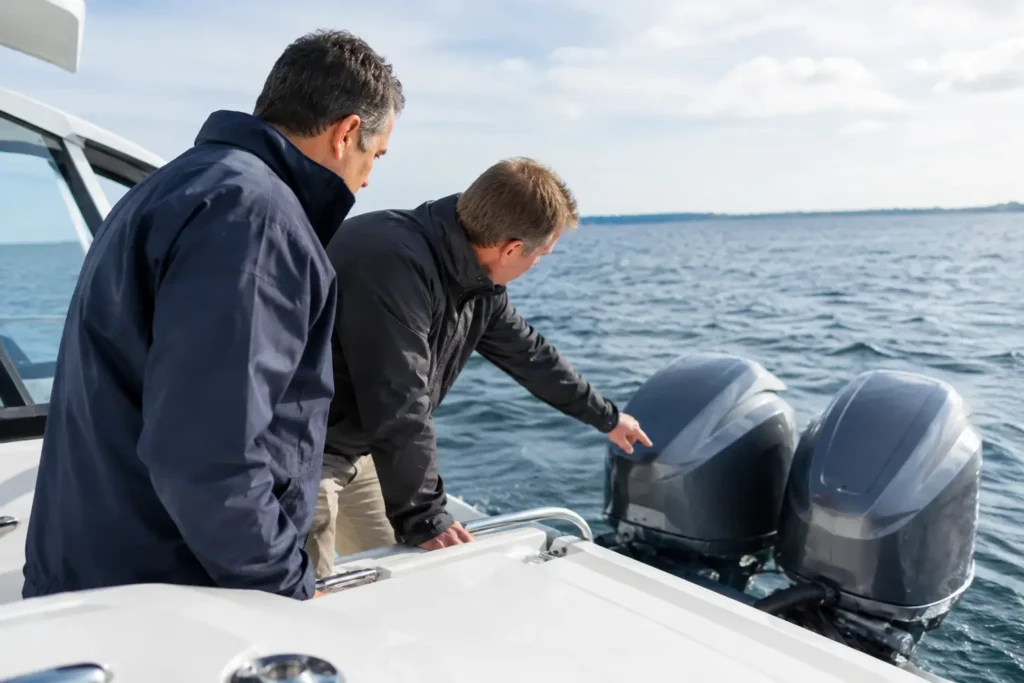
The prudent response is not to continue at full throttle in the hope that the alarm clears. The throttle is reduced, temperatures are allowed to stabilise, and the event is recorded with the engine speed, sea conditions, operating time, and instrument readings. The surveyor will also note whether there is smoke, loss of power, unusual exhaust discharge, coolant odour, or evidence of a leak.
At this stage, the failure is a symptom, not a diagnosis. Possible causes can range from a partially blocked seawater intake or fouled heat exchanger to a restricted exhaust elbow, failing raw-water pump, damaged impeller, thermostat issue, coolant circulation problem, or an underlying engine defect. The cost difference between these possibilities is substantial. A buyer should not accept reassurance that it is “probably only an impeller” without evidence.
Why load matters
Many marine systems behave normally at idle and low speed. Cooling capacity, fuel delivery, turbocharger performance, shaft alignment, exhaust flow, and electrical charging are tested far more meaningfully when the yacht is driven at realistic operating loads.
A short engine run alongside cannot replicate this. In the example above, the port engine may idle for an hour without concern, yet overheat within minutes once the yacht is asked to plane or hold normal cruising speed. That distinction is exactly why a sea trial is a central part of technical due diligence, not a ceremonial final step before signing.
The investigation after the failure
A proper investigation proceeds in a controlled sequence. First, the surveyor verifies the basic facts: is the indicated temperature credible, are both engines operating at comparable rpm, and are the test conditions reasonably similar? Instrument faults do occur, but they should be confirmed rather than assumed.
The inspection then turns to accessible evidence. This may include checking seawater strainers, hose condition, belt tension, coolant level, visible leaks, exhaust water flow, engine-room ventilation, and service history. If the engine is fitted with electronic diagnostics, fault codes and recorded operating data may provide useful context. Oil and coolant samples can also be considered where findings justify further assessment.
Some work falls outside the scope of a visual survey and requires an engine specialist. Removing and bench-testing a heat exchanger, inspecting an exhaust mixing elbow internally, pressure-testing the cooling circuit, or carrying out compression and borescope checks are invasive procedures. They are often sensible next steps, but the buyer should understand who will perform them, what they will cost, and what question each test is intended to answer.
This is where independence matters. A surveyor should describe the evidence, identify the risks, and recommend proportionate further investigation. The surveyor should not minimise an unresolved defect to preserve a transaction, nor present a worst-case scenario as an established fact.
A failed sea trial does not always end the purchase
A sea trial failure can lead to several reasonable outcomes. If a qualified engineer identifies a straightforward cause, completes the repair, and the yacht later passes a documented repeat trial, the purchase may continue with confidence. This is common with maintenance-related defects that have a clear remedy.
The position changes when the cause remains uncertain, the fault recurs, or the evidence points to a more significant issue. Persistent overheating could indicate neglected maintenance across multiple systems. It may also suggest that the yacht has been operated despite warnings. That raises questions about engine life, previous repairs, resale value, and the reliability of the seller’s maintenance records.
A buyer may then ask for a price adjustment, a retention held until repairs and a repeat trial are completed, or a contractual right to withdraw. The right solution depends on the purchase agreement, the vessel’s value, the time available, and the buyer’s appetite for project risk. For a first-time owner, accepting a technically uncertain propulsion issue can turn an exciting purchase into an expensive and disruptive first season.
Other failures that sea trials can reveal
Overheating is only one example. A properly planned trial can expose faults that are not apparent at the dock, particularly where they occur only with speed, load, heat, or vibration.
A noticeable vibration at a specific rpm may indicate fouled running gear, a bent propeller, shaft misalignment, worn cutless bearings, engine-mount deterioration, or damage beneath the waterline. A yacht that cannot reach its expected rpm may have propeller mismatch, hull fouling, fuel restriction, turbocharger problems, or an engine performance issue. Slow steering response, autopilot faults, abnormal gearbox engagement, excessive smoke, battery-voltage instability, and water ingress at speed also require careful interpretation.
Not every irregularity has the same consequence. A non-functioning trim-tab indicator and a gearbox that hesitates before engaging are both defects, but they do not carry the same safety, cost, or negotiating weight. A good survey report separates observation from diagnosis and prioritises findings according to operational significance.
How buyers can protect their position
The sea trial should be agreed as a condition of purchase, not treated as a favour granted after the main commercial terms are settled. The agreement should allow enough time for engines to reach operating temperature, for the yacht to be tested through a sensible rpm range, and for any significant concern to be assessed before completion.
Weather and sea state matter. Extremely rough conditions may make a trial unsafe or prevent useful speed and vibration observations. Conversely, very calm water can conceal handling issues that appear in a moderate seaway. A surveyor will record conditions because test results need context. The aim is not to force a yacht beyond sensible limits, but to obtain evidence that reflects normal operation.
Buyers should also ask for relevant records before the trial: engine service documentation, repair invoices, previous survey reports where available, and details of recent lay-up or recommissioning. Records do not replace inspection, but they help establish whether a finding is isolated or part of a longer pattern.
In Bodrum and across the wider Turkish and eastern Mediterranean market, it is particularly sensible to consider how a yacht has been used and maintained between seasons. Extended inactivity, warm-water fouling, variable maintenance standards, and long periods connected to shore power can all influence the condition of machinery and onboard systems.
A sea trial is not designed to promise that no future defect will occur. It is a disciplined opportunity to reveal present evidence of risk while the buyer still has choices. When a failure appears, the most valuable next step is calm, documented investigation by independent professionals. That approach gives the buyer a basis for an informed decision, whether that means proceeding after repair, renegotiating the price, or leaving the yacht for a better opportunity.