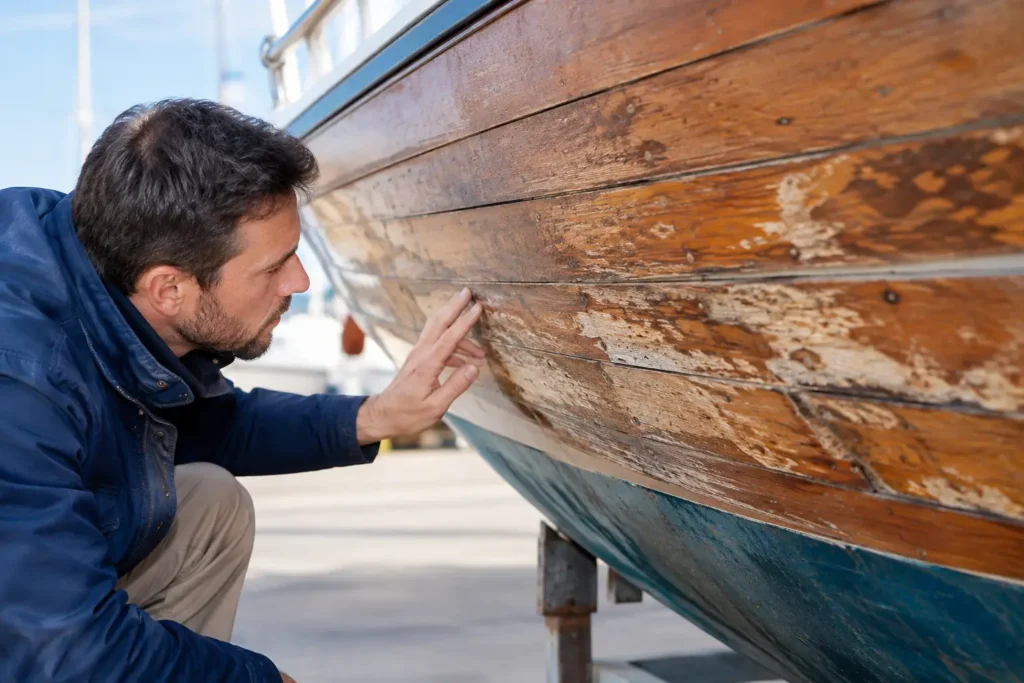
A well-built wooden yacht can be a remarkable vessel: strong, repairable, and full of character. It can also conceal costly deterioration beneath paint, fairing compound, internal linings, and a freshly presented bilge. The most significant warning signs in wooden hulls are rarely limited to one soft plank or a little water staining. They are patterns that indicate how the vessel has been built, maintained, used, and stored.
For a buyer, the question is not whether a wooden hull has imperfections. Almost every older wooden boat will have some. The question is whether those imperfections are local and manageable, or evidence of a wider structural, moisture, or maintenance problem that changes the vessel’s value and refit risk.
Warning Signs in Wooden Hulls: Look for Patterns
A wooden hull should be assessed as a system. Planking, frames, floors, fastenings, caulking, coatings, deck structure, ventilation, and bilge management all affect one another. A repair may be entirely appropriate, while repeated repairs in the same area may indicate that the underlying cause has not been addressed.
Fresh paint deserves careful interpretation. It is not automatically a concern, as owners often repaint before sale or as part of normal upkeep. However, a newly finished topside, antifouling applied over questionable preparation, or immaculate paintwork alongside neglected machinery spaces should prompt closer examination. A surveyor will look for inconsistencies between the presentation of the vessel and the condition of its concealed or less visible structure.
The history matters as much as the appearance. Details such as the construction method, timber species, age of the fastenings, prior replanking, winter storage arrangements, and records of major repairs provide essential context. A traditionally planked hull behaves differently from cold-moulded, strip-planked, or laminated construction, and the likely defects are not identical.
Plank Movement, Open Seams, and Distorted Fairness
Open seams can be normal in a wooden vessel that has been ashore and allowed to dry. Timber moves with changing moisture content, and a hull may take up after relaunching. The concern is not simply the presence of seams, but their size, location, consistency, and associated damage.
Localised wide seams, cracked caulking, displaced plank edges, or repeated seam compound failures may indicate movement beyond normal seasonal change. On a traditionally planked hull, this can result from weakened frames, deteriorated fastening heads, poor plank fit, excessive drying, or a hull that has lost its original shape. Where the lines of the hull appear uneven, particularly around the turn of the bilge, garboards, or butt ends, further investigation is warranted.
Pay attention to hard points around chainplates, engine beds, shaft exits, deck fittings, and keel connections. These areas receive concentrated loads and are often vulnerable to water ingress. A cosmetic fairing repair may make a distorted area look acceptable from a distance while leaving the structural cause unresolved.
Soft Timber Is a Symptom, Not a Diagnosis
Softness found by probing is one of the better-known concerns in wooden boats, but it must be interpreted properly. Decay requires moisture, oxygen, and a suitable temperature range. Its presence tells the surveyor that prolonged wet conditions have existed, yet the extent of the affected timber cannot be assumed from one accessible spot.
Particularly sensitive locations include the ends of frames, beam shelves, deck beams, lodging knees, floors, stem and sternpost areas, chainplate landings, and the interface between the keel and hull planking. Water can travel through joints and along fastenings, so the visible stain or soft section is not always the origin of the problem.
A screwdriver test alone is not a survey methodology. It can damage sound timber and provides only limited information. Professional assessment combines visual inspection, careful sounding, moisture readings where appropriate, access to both sides of a structure, and an understanding of how that particular vessel was constructed. In some cases, opening selected linings or removing inspection covers is necessary before the true condition can be established.
Moisture meters are useful comparative tools, not definitive proof of decay. Readings may be influenced by timber species, salt content, surface moisture, coatings, metal fastenings, and calibration. Elevated readings should lead to questions: Is the timber wet because of an active leak? Is the area unable to dry because of poor ventilation? Is it a temporary condition after recent launching, or a long-standing issue within the structure?
Fastening Failure Can Be Hidden Until It Is Serious
Many wooden hulls rely on thousands of metal fastenings to secure planking to frames. Depending on age and construction, these may be copper, bronze, galvanised steel, stainless steel, or another material. Their condition is critical, but it is often difficult to assess without targeted access or removal of representative samples.
Fastening deterioration can allow planks to work against frames, widen seams, and admit water. In severe cases, a hull may retain a fair external appearance while the mechanical connection between plank and frame has weakened substantially. Dark staining around fastening heads, raised or loose planks, repeated caulking failure, and unexplained movement under modest pressure can all justify deeper investigation. Spotting fastener fatigue and framing rot requires expert assessment, which you can compare against what is included in a marine survey for wooden vessels.
The risk varies considerably. Copper and bronze fastenings may have long service lives when correctly specified and installed, while galvanised fastenings in an older vessel can require more urgent attention. Mixed-metal repairs also deserve scrutiny because galvanic interaction can accelerate corrosion. A claim that a hull has been “refastened” should be supported by records describing the scope, materials, and dates of the work. Partial refastening may be sensible, but it is not the same as a comprehensive programme.
Bilges, Keels, and the Cost of Persistent Water
A wet bilge is not always a defective bilge. Some wooden vessels have practical reasons for carrying a small amount of water, particularly after use. Persistent standing water, however, creates conditions that deserve careful attention. It can conceal deterioration in floors and keel bolts, encourage rot in adjacent timber, and make it difficult to distinguish rainwater, plumbing leaks, seawater ingress, or oil-contaminated discharge.
The condition of the limber holes is relevant. If they are blocked, water cannot drain properly through the structure. If they have been enlarged carelessly, structural members may be compromised. Staining, corrosion, degraded paint systems, and deposits in inaccessible bilge areas can reveal a history of poor drainage even when the bilge has been cleaned for inspection.
Keel bolts require a measured assessment. Surface corrosion on exposed nuts is not, by itself, evidence that the bolts are unsafe. Conversely, clean-looking nuts do not prove that the embedded bolt shanks are sound. The materials used, vessel age, bilge environment, grounding history, and signs of movement at the keel-hull joint all influence the risk. Where concerns are identified, further investigation may include selected bolt testing or removal, subject to the owner’s agreement and the survey scope.
Deck Leaks Often Become Hull Problems
Water entering through a failed deck seam, stanchion base, chainplate, hatch coaming, or deck fitting can travel into structural spaces for years. The eventual damage may appear at a frame end or bulkhead far below the original leak. This is why a wooden yacht survey should not treat deck and hull as separate subjects.
Warning signs include dark rings around fasteners, local deck softness, leaking interior liners, staining at bulkhead joins, and cracked paint around heavily loaded fittings. Teak decks deserve particular care. Worn caulking, thin remaining timber, exposed fasteners, and repeated screw-hole repairs can turn a deck replacement from a cosmetic project into a major structural and financial decision.
Ventilation is equally relevant. Closed lockers, poorly ventilated forepeaks, damp sail stowage spaces, and insulated areas around tanks can remain wet long after an obvious leak has stopped. Good maintenance is not only about keeping water out. It is also about allowing unavoidable moisture to escape and dry.
Separate Maintenance Needs From Transaction Risk
No survey should create unnecessary alarm simply because a vessel is wooden. Timber is repairable, and localised repairs can be technically sound and economically reasonable. A properly executed replacement frame, plank repair, or deck repair may improve a vessel rather than diminish it.
The transaction risk rises when findings are widespread, inaccessible, poorly documented, or linked to primary structure. It also rises when the repair method appears unsuitable, when prior work has trapped moisture, or when the seller cannot explain significant changes in the vessel’s condition. For buyers, the practical issue is whether the purchase price, planned use, and available refit budget reflect the true scope of work.
An independent pre-purchase survey brings discipline to this decision. At The Blue Matter, the objective is not to condemn a wooden yacht for having age or history. It is to identify evidence, explain its significance, state the limits of what can be seen, and help the client decide what further investigation or negotiation is justified.
Before committing to a wooden yacht, allow enough time for a proper out-of-water inspection and ask direct questions about repairs, storage, and maintenance records. The right vessel is not necessarily the one with the newest paint or the driest sales brochure. It is the one whose condition is understood well enough for you to proceed with clear expectations and a realistic plan.
About the Author
Mustafa Aksut is an experienced independent marine surveyor, yacht refit project manager, and founder of Blue Matter Marine Consulting in Turkey. Holding an Associate IIMS designation and professional membership with the American Boat and Yacht Council (ABYC), he specializes in pre-purchase yacht condition surveys, thermal imaging diagnostics, technical due diligence, and new build project oversight. Operating with 100% independent loyalty to the client, Mustafa never practices brokerage, performs repair work, or acts for boatyards and refit centers—ensuring strictly unbiased surveys and uncompromised owner representation.